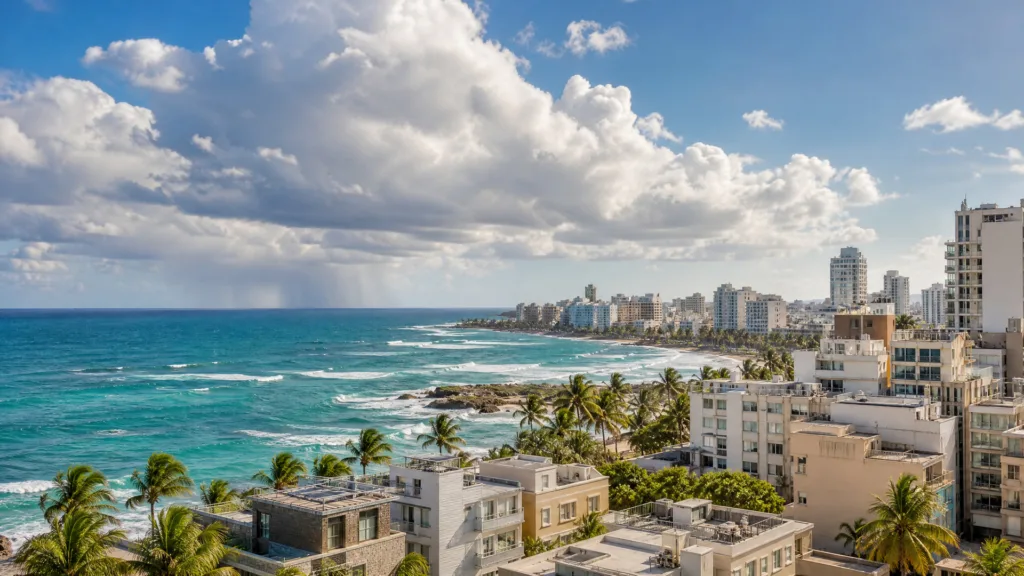
Puerto Rico’s tropical marine setting delivers warm temperatures in every month, with humidity and rainfall shifting through the year. For planning, the most reliable baseline is NOAA’s 1991 to 2020 climate normals, which describe typical conditions by month and location. Normals explain what is usual, not what will happen on a given date, so they should inform expectations rather than serve as a forecast 1. This guide uses those baselines to outline San Juan’s temperatures, the island’s wet and relatively dry periods, storm and ocean hazards, and practical packing and housing considerations.
How to read the climate picture in San Juan
NOAA’s state climate summary reports a 1991 to 2020 annual average temperature of 81.0°F for San Juan, illustrating the island’s dependable warmth 2. At the edges of the year, the range is modest: January normals in San Juan average 72.0°F at night and 83.2°F by day, while August averages about 77.8°F at night and 89.1°F by day 2. Those values frame the experience for most coastal visitors.
Normals summarize the long-term signal, not a guarantee for your dates. Keep these points in mind when using them 1:
- Normals smooth out year-to-year swings, so a specific week can be hotter, cooler, wetter, or drier than the 30-year average.
- Elevation and exposure matter. Interior mountains trend cooler and wetter than the north coast, and windward slopes receive more rain than leeward areas 2.
- Ocean conditions do not always mirror sky conditions. Even on sunny days, swells and rip currents may be hazardous.
Seasonal patterns at a glance
Puerto Rico’s year divides into a relative dry season and a wet season. The state climate summary identifies a broadly defined wet season from May to October and a relatively drier period from November to April, with local variations by region and elevation 2. On the north coast around San Juan and Condado, those patterns show up as passing showers in summer and more consistently dry stretches in winter.
Here is a planning view that aligns travel choices with the seasonal signal:
| Window | Typical pattern | Ocean and storm notes | Planning notes |
|---|---|---|---|
| November to April (relative dry) | Lower humidity and fewer rain days compared with summer | Swells vary; winter cold fronts can bring surf; rip currents can occur any month | Popular for beach time and city exploring; higher demand on peak holiday weeks 2 |
| May to June (transition to wet) | Humidity builds; showers increase, often brief | Early-season tropical waves can enhance rain | Good daylight for outdoor plans; carry light rain gear |
| July to October (wettest window) | Warmest, most humid months; frequent showers or thunderstorms, often in the afternoon | Peak of Atlantic hurricane season; sea conditions can shift quickly | Flex itineraries; watch official forecasts and advisories 24 |
What the seasonal labels mean in practice
- Expect passing showers even in the relative dry season. Rainforest zones such as El Yunque remain wet year-round, while San Juan’s coastal neighborhoods can go many hours or days between showers in mid-winter 2.
- Afternoon convection is common in the wet season. Mornings may start bright, with clouds and showers building later, then clearing again toward evening.
- Tropical systems are episodic. The Atlantic hurricane season spans June to November, but most days even in peak months are not storm days at any given point on the island 3.
Daily weather behavior on the north coast
San Juan’s day-to-day weather follows readable rhythms that help with scheduling beach time, errands, and work.
- Trade-wind breeze: Light to moderate easterly flow is common, keeping air moving and moderating heat near the shore. Inland areas feel warmer when winds slacken.
- Heat and humidity: With ocean-warmed air and summer sun, heat index values can exceed air temperature. Shade, breathable fabrics, and frequent hydration help.
- Passing showers: Showers can arrive fast, drop a quick burst of rain, then drift out as quickly. Many last minutes, not hours, though widespread rainy days do occur in the wet season.
- Overnight reset: Nights are warm but often more comfortable, especially in winter months when temperatures trend toward the low 70s in San Juan’s normals 2.

Microclimates across the island
- North and east coasts: More exposure to trade-wind moisture. Showers are more frequent compared with western and southern leeward pockets.
- Central mountains: Cooler and wetter than the coast. Cloud build-up and fog are common on ridge lines.
- South coast: Often drier in relative terms. Sunshine hours can be higher, but summer heat can feel more intense away from the sea breeze 2.
Hurricane season and ocean safety
The Atlantic hurricane season runs from June 1 to November 30. Tropical cyclones can bring wind, heavy rain, storm surge, flooding, and infrastructure disruption. Planning should separate the length of the season from the chance that any single trip is affected, and it should rely on official guidance 24.
Monitoring and decision points
- Use the National Hurricane Center for outlooks, storm tracks, and advisories before and during travel 3.
- Check the NWS San Juan forecast office for local watches, warnings, rainfall potential, and marine statements 4.
- Build flexibility into summer and early fall plans. If a disturbance forms, adjust itineraries early rather than late.
Ocean hazards and rip-current awareness
Rip currents occur year-round and can form under sunny skies. Read posted beach warnings, talk with lifeguards when present, and avoid inlets and rocky points during strong surf. If caught in a rip, remain calm, float, and swim parallel to shore to exit the current before returning to the beach 6.
Practical readiness for stays of any length
- Keep a small weather kit: compact rain shell, quick-dry layers, brimmed hat, and reef-safe sunscreen.
- During peak wet months, add a lightweight umbrella and a dry bag for electronics; in the heart of the season, a small flashlight and charged power bank are sensible backups.
- For extended stays, confirm your building’s storm procedures and communication channels, and review where to park and how to handle elevator outages if a prolonged power cut occurs.
Packing: what earns space in your bag
Build around breathable, sun-smart pieces and a simple rain plan. Climate normals point to warmth in every month, so light layers outperform heavy gear 1.
- Clothing: quick-dry shirts, shorts, and dresses; a packable rain jacket; a light long-sleeve layer for sun and air-conditioned interiors.
- Sun protection: UPF shirt, wide-brim hat, polarized sunglasses, and broad-spectrum reef-safe sunscreen.
- Footwear: sandals for the beach, supportive walking shoes for Old San Juan’s hills and pavers, and water shoes for rocky entries.
- Beach and pool: microfiber towel, reusable water bottle, and a small dry bag for phones and keys.
- Health and comfort: insect repellent, basic first-aid items, and any personal prescriptions. If sensitive to dust or pollen, consider a small pack of saline eye drops.
- Electronics: compact charger, travel power strip with surge protection, and a power bank.
Weather and booking strategy
Demand in Puerto Rico reflects both climate and the event calendar. The relative dry season aligns with many travelers’ preferences for lower humidity and fewer rain days. Discover Puerto Rico reported that 2025 set records across key tourism indicators, a reminder that peak and holiday weeks can compress availability even when day-to-day weather is excellent 5. If dates are fixed, hold specific units earlier; if flexible, shoulder periods at the edges of winter and spring can trade a few passing showers for quieter beaches and broader choice.
For help timing a vacation rental around weather tolerance and unit specificity, see the package article on the best timing to book in Condado at best time to book a Condado vacation rental.
Weather, work, and housing resilience in Condado
Remote workers and long-stay guests should link climate awareness to practical apartment questions. Ask about internet service type, measured performance on wired and Wi‑Fi connections, and any backup connectivity. Clarify the scope of generator coverage and the presence of a water cistern, and request details on what those systems power and for how long. In humid months, confirm air-conditioning maintenance schedules and filter changes. For beach-adjacent living, a balcony with airflow can make mid-afternoon heat more tolerable, while blackout shades can keep bedrooms cooler after sunrise.
For a weather-resilient base near the shore, KTJ Krug operates 10 furnished Condado units across the street from the beach. Select apartments include continuity features such as a building generator, a water cistern, and up to 1 Gbps fiber, and pet-friendly options are available. Review dates, specifications, and direct terms at book direct.
What the numbers do not say
Climate normals guide expectations, but they are not day-by-day predictions. A January week can run hotter than average, and a July trip can thread several dry days. Tropical cyclones are high-impact but relatively rare on any particular date and address. The best approach is to make decisions with official information, build small buffers into plans, and choose accommodations that communicate clearly about continuity and safety 13.
For remote work logistics such as fiber options, wired Ethernet, and backup power checks, see the package guide at digital nomad internet and coworking guide.
A practical weather routine is more useful than reacting to a single forecast. Check the National Weather Service each morning, keep rain protection available for short outdoor trips, and confirm how the building communicates power, elevator, and water updates. For longer stays, review generator coverage, cistern procedures, window protection, and the location of interior rooms before the wetter part of the year. Remote workers should also keep devices charged and maintain a mobile data option. These steps support continuity without treating normal tropical showers as emergencies or assuming that backup systems eliminate all disruption risk 1.
References
Frequently Asked Questions
Is Puerto Rico warm year-round?
Yes. NOAA’s 1991 to 2020 normals show San Juan’s annual average temperature at 81.0°F, with January and August differing by only a few degrees in typical daytime highs 2. Conditions vary by location and elevation, with the interior mountains cooler and wetter than the coast.
When is the rainy season in Puerto Rico?
Puerto Rico’s broadly defined wet season runs from May to October, while November to April is relatively drier on average 2. Even in the dry season, brief showers can occur, and rainforest zones receive substantial rain in any month.
What months are in the Atlantic hurricane season?
The Atlantic hurricane season runs June 1 to November 30 3. Most days, even in peak months, are not storm days in a specific location, but plans should monitor official outlooks and advisories.
How risky are rip currents around San Juan?
Rip currents can occur at any time of year, often during or after periods of stronger surf. Follow posted warnings, swim near lifeguards when available, and know to float and swim parallel to shore to exit a rip before returning to the beach 6.
What should a renter pack for Puerto Rico in summer versus winter?
In both seasons, prioritize breathable clothing, sun protection, and hydration. Summer adds higher humidity and more frequent showers, so include a packable rain shell and a dry bag; winter can be slightly cooler at night, so bring a light long-sleeve layer for comfort.
Related
If you are planning around the season rather than a weekend, an apartment beats a hotel on cost and space. extended-stay apartments instead of a hotel.